Artificial Intelligence has become one of the biggest study companions for students worldwide. Whether you’re writing essays, preparing for exams, learning to code, or researching a difficult topic, ChatGPT can save hours of work—if you know how to ask the right questions.
The secret isn’t just using ChatGPT. It’s using high-quality prompts that tell the AI exactly what you need.
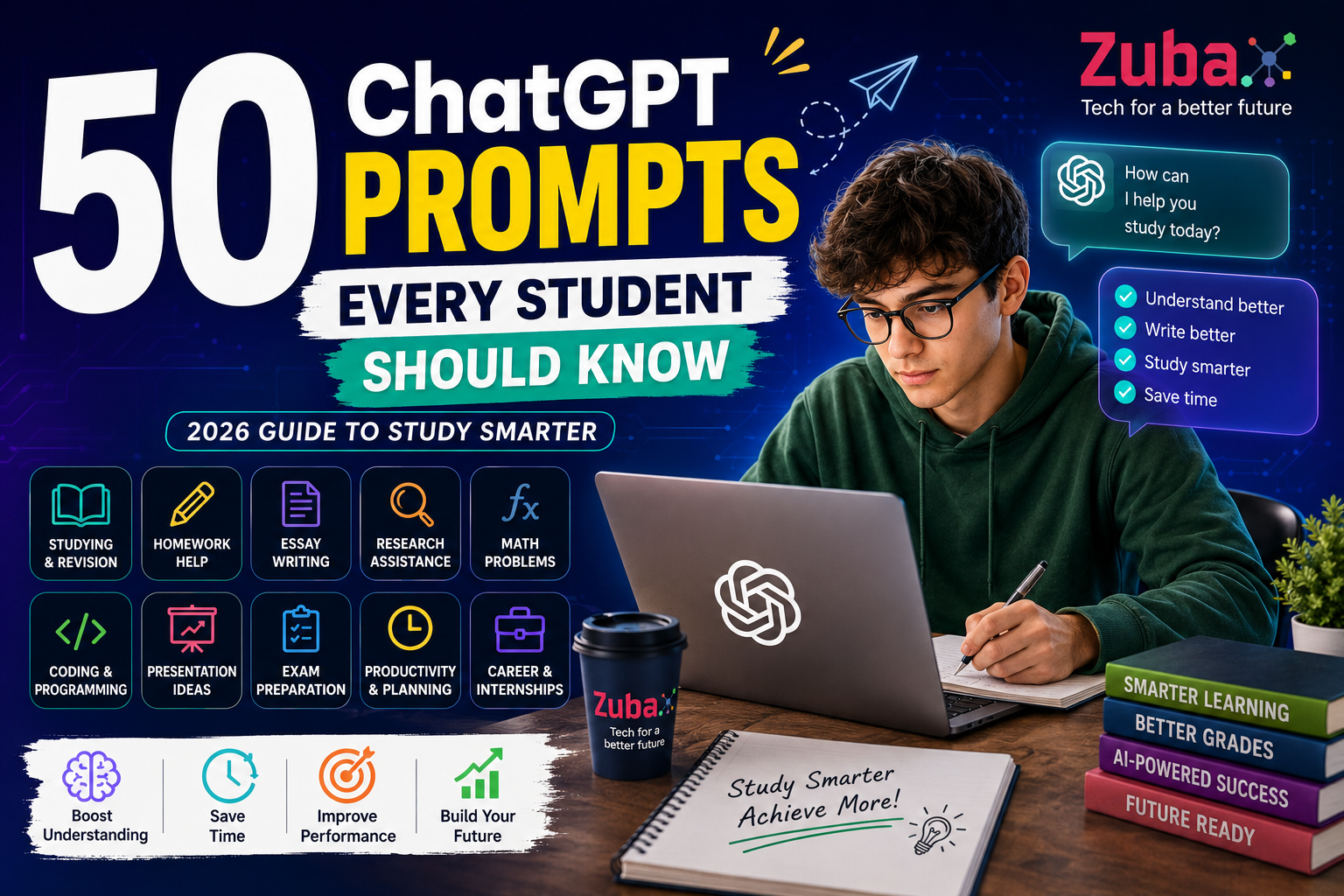
In this guide, you’ll discover 50 powerful ChatGPT prompts for students that can help you:
- Study faster
- Understand difficult subjects
- Write better assignments
- Prepare for exams
- Improve research
- Learn programming
- Create presentations
- Become more productive
Let’s get started.
Why Good Prompts Matter
Many students type questions like:
Explain photosynthesis.
Instead, try:
Explain photosynthesis like I’m a 15-year-old student. Use simple English, diagrams in text, and include three real-life examples.
The second prompt gives significantly better results.
The more specific your prompt is, the better ChatGPT performs.
Study Prompts
Prompt 1 – Explain Difficult Topics
Prompt
Explain [topic] as if you’re my personal tutor. Use simple language, real-life examples, and summarize everything at the end.
Prompt 2 – Create Study Notes
Prompt
Create detailed study notes about [topic]. Include definitions, important concepts, examples, and key points for exams.
Prompt 3 – Make Flashcards
Prompt
Turn this chapter into 30 flashcards with questions on one side and answers on the other.
Prompt 4 – Quiz Me
Prompt
Ask me 20 multiple-choice questions about [topic]. Don’t reveal the answers until I finish.
Prompt 5 – Simplify Textbooks
Prompt
Rewrite this textbook chapter into simple English suitable for high school students.
Homework Prompts
Prompt 6 – Homework Helper
Help me solve this homework problem step-by-step without giving me the final answer immediately.
Prompt 7 – Check My Work
Review my homework and identify mistakes. Explain why they’re incorrect and suggest improvements.
Prompt 8 – Brainstorm Ideas
Give me 20 creative ideas for this assignment. Rank them from easiest to most unique.
Prompt 9 – Summarize Long Articles
Summarize this article in under 300 words while keeping all important information.
Prompt 10 – Compare Topics
Compare [Topic A] and [Topic B] using a table that highlights similarities and differences.
Essay Writing Prompts
Prompt 11 – Essay Outline
Create a detailed outline for a 2,000-word essay about [topic].
Prompt 12 – Improve Writing
Rewrite my essay to improve clarity, grammar, and academic tone without changing my original ideas.
Prompt 13 – Strong Introduction
Write an engaging introduction for an essay about [topic] that immediately captures the reader’s attention.
Prompt 14 – Strong Conclusion
Write a powerful conclusion that summarizes the key arguments and leaves a lasting impression.
Prompt 15 – Generate Thesis Statement
Create five strong thesis statements for an essay about [topic].
Research Prompts
Prompt 16 – Research Plan
Create a complete research plan for my project on [topic], including objectives, methodology, and sources.
Prompt 17 – Find Research Questions
Generate ten unique research questions related to [topic].
Prompt 18 – Explain Research Papers
Explain this research paper in simple language suitable for undergraduate students.
Prompt 19 – Literature Review
Summarize the key findings from multiple sources on [topic] and organize them into a literature review.
Prompt 20 – APA Citations
Format these references correctly in APA 7th Edition style.
Quick Tips for Better Results
- Be specific with your requests.
- Mention your education level.
- Tell ChatGPT the desired output format.
- Ask for examples.
- Request tables when comparing information.
- Ask ChatGPT to explain its reasoning step by step for complex concepts.
Programming & Coding Prompts
Whether you’re learning Python, Java, C++, JavaScript, or any other programming language, ChatGPT can act as a coding mentor. Instead of asking it to simply generate code, use prompts that help you understand the logic behind each solution.
Prompt 21 – Explain Code
Prompt
Explain this code line by line in beginner-friendly language. Tell me what each function, variable, and loop does.
Prompt 22 – Debug My Code
Prompt
Find the errors in this code, explain why they happen, and provide the corrected version with comments.
Prompt 23 – Learn a Programming Language
Prompt
Create a 30-day learning roadmap for beginners who want to learn [Programming Language] from scratch.
Prompt 24 – Generate Practice Problems
Prompt
Create 10 beginner, 10 intermediate, and 10 advanced coding exercises about [topic].
Prompt 25 – Optimize My Code
Prompt
Improve this code for better performance and readability. Explain every optimization you make.
Mathematics Prompts
Math becomes much easier when ChatGPT explains concepts step by step instead of simply giving the answer.
Prompt 26 – Solve Step-by-Step
Prompt
Solve this math problem step by step and explain every calculation as if you’re teaching a beginner.
Prompt 27 – Explain Formulas
Prompt
Explain this formula, what each variable represents, when to use it, and solve one example.
Prompt 28 – Practice Questions
Prompt
Generate 20 practice questions on [topic] with increasing difficulty.
Prompt 29 – Check My Solution
Prompt
Review my solution, identify mistakes, and explain how to solve the problem correctly.
Prompt 30 – Create a Formula Cheat Sheet
Prompt
Create a one-page cheat sheet containing the most important formulas for [subject] with short explanations.
Presentation Prompts
Presentations are common in schools and universities. ChatGPT can help you organize your ideas and create engaging slides.
Prompt 31 – Create Presentation Outline
Prompt
Create a professional 10-slide presentation outline on [topic].
Prompt 32 – Speaker Notes
Prompt
Write speaker notes for every slide so I can confidently present this topic.
Prompt 33 – Presentation Script
Prompt
Write a five-minute presentation script using simple, natural English.
Prompt 34 – Improve Slides
Prompt
Suggest better headings, visuals, and design ideas for my presentation slides.
Prompt 35 – Audience Questions
Prompt
Generate 15 questions that my teacher or classmates may ask after this presentation and provide ideal answers.
Exam Preparation Prompts
Preparing for exams is one of the best uses of ChatGPT. These prompts can help you revise more effectively and identify weak areas.
Prompt 36 – One-Week Study Plan
Prompt
Create a detailed 7-day study schedule for my upcoming [subject] exam.
Prompt 37 – Mock Exam
Prompt
Create a realistic exam paper with multiple-choice, short-answer, and essay questions based on this syllabus.
Prompt 38 – Memorization Techniques
Prompt
Teach me easy memory techniques to remember the important concepts from [topic].
Prompt 39 – Explain My Mistakes
Prompt
I answered these questions incorrectly. Explain my mistakes and teach me the correct concepts.
Prompt 40 – Last-Minute Revision
Prompt
Summarize everything I need to know about [topic] in less than 10 minutes of reading.
Pro Tips for Better ChatGPT Prompts
Want even better responses? Follow these simple tips:
1. Give Context
Instead of asking:
Explain climate change.
Ask:
Explain climate change to a first-year university student studying environmental science.
2. Specify the Output Format
Examples include:
- Bullet points
- Tables
- Flashcards
- Mind maps
- Timeline
- Quiz
- Summary
- Step-by-step guide
3. Mention Your Goal
Example:
I have an exam tomorrow. Focus only on the most important concepts that are frequently asked in exams.
4. Ask for Examples
Concepts become much easier when ChatGPT provides practical examples.
Example:
Explain object-oriented programming using real-world examples.
5. Request Different Difficulty Levels
Example:
Explain quantum computing at beginner, intermediate, and advanced levels.
Common Mistakes Students Make
Avoid these mistakes when using ChatGPT:
- Asking vague questions
- Copying AI-generated content directly into assignments
- Not fact-checking important information
- Forgetting to ask for examples
- Ignoring source citations for academic work
- Relying entirely on AI instead of understanding the material
Remember, ChatGPT works best as a learning assistant—not a replacement for your own critical thinking and study efforts.
Productivity Prompts
Time management is just as important as studying. These prompts can help students stay organized and get more done with less stress.
Prompt 41 – Create a Daily Study Schedule
Prompt
Create a personalized daily study schedule for me. I have [X] hours available each day and need to prepare for [subjects]. Include study sessions, breaks, and revision time.
Prompt 42 – Build a Weekly Productivity Plan
Prompt
Create a productive weekly timetable that balances studying, assignments, exercise, and personal time.
Prompt 43 – Break Down Large Projects
Prompt
Divide this assignment into small, manageable tasks with deadlines so I can finish it before the due date.
Prompt 44 – Beat Procrastination
Prompt
Act as a productivity coach. Help me overcome procrastination using practical strategies and create a simple action plan.
Prompt 45 – Prioritize My Tasks
Prompt
Here is my to-do list. Rank each task by priority and estimate how long each one should take.
Career & Internship Prompts
ChatGPT isn’t just for academics—it can also help students prepare for internships, scholarships, and future careers.
Prompt 46 – Resume Improvement
Prompt
Review my resume and suggest improvements to make it more attractive for internships and entry-level jobs.
Prompt 47 – Cover Letter
Prompt
Write a professional cover letter for a student applying for a [position]. Highlight transferable skills and academic achievements.
Prompt 48 – Interview Preparation
Prompt
Conduct a mock interview for a [job or internship]. Ask common interview questions, wait for my answers, and provide feedback.
Prompt 49 – Scholarship Essay
Prompt
Help me create a compelling scholarship essay. Ask me questions first, then use my answers to build an authentic essay.
Prompt 50 – Career Roadmap
Prompt
Create a step-by-step career roadmap for becoming a [career] after graduation, including skills, certifications, internships, and learning resources.
Tips for Using ChatGPT Responsibly
ChatGPT is a powerful learning assistant, but it should be used ethically.
Here are some best practices:
- Use ChatGPT to understand concepts instead of copying answers.
- Always verify important facts with trusted academic sources.
- Add your own ideas, analysis, and writing style to assignments.
- Check your institution’s AI usage policy before submitting AI-assisted work.
- Cite sources appropriately when required.
Using AI responsibly helps you learn more effectively while maintaining academic integrity.
Frequently Asked Questions
What are the best ChatGPT prompts for students?
The best prompts are those that clearly describe your goal, education level, and preferred output format. Specific prompts generally produce more useful and accurate responses than short or vague questions.
Can ChatGPT help with homework?
Yes. ChatGPT can explain concepts, guide you through problems, generate practice questions, and review your work. It’s most valuable as a learning companion rather than a tool for copying answers.
Is ChatGPT free for students?
ChatGPT offers a free version with useful capabilities for studying, writing, brainstorming, and coding. Additional features may be available through paid plans.
Can ChatGPT improve grades?
Used responsibly, ChatGPT can help students understand difficult topics, organize study sessions, improve writing, and prepare more effectively for exams. Your results will still depend on consistent effort and critical thinking.
What subjects can ChatGPT help with?
ChatGPT can assist with many subjects, including:
- Mathematics
- Science
- History
- Literature
- Computer Science
- Business
- Economics
- Engineering
- Psychology
- Foreign Languages
Final Thoughts
Learning how to write effective prompts is one of the most valuable digital skills students can develop in 2026. Instead of treating ChatGPT as a shortcut, use it as a personal tutor, writing coach, research assistant, coding mentor, and productivity partner.
The 50 prompts in this guide cover everything from studying and essay writing to coding, presentations, research, and career preparation. Save this article, experiment with different prompts, and adapt them to your own learning style.
As AI continues to transform education, students who know how to ask better questions will be better prepared for academic success and future careers.
If you found this guide helpful, explore more AI tutorials and productivity resources on Zubatecno to stay ahead with the latest technology trends.
Related Articles (Internal Links)
Add links to relevant Zubatecno articles such as:
- Best Free AI Tools for Students in 2026
- ChatGPT vs Gemini: Which AI Is Better?
- Best AI Productivity Apps
- Best Note-Taking Apps for Students
- Top AI Websites Every Student Should Bookmark
Suggested External Resources
For additional learning, consider linking to:
- OpenAI
- Google AI
- Microsoft Learn
- Purdue Online Writing Lab (OWL)
- Harvard Writing Center
Conclusion
Whether you’re studying for exams, writing assignments, preparing presentations, or planning your career, the right ChatGPT prompt can save time and improve your learning experience.
Bookmark this guide and revisit it whenever you need inspiration. As new AI features are released, we’ll continue updating this list so you always have access to the most effective ChatGPT prompts for students.
Also Read This Article: 12 Best Note-Taking Apps for College Students (2026 Guide)